
By: Bolanle Dada (RD), Research Scientist at Less Is Adequate
One of the biggest issues facing the global food system today is an interconnected crisis often referred to as the global syndemic, where three major problems co-exist: undernutrition, obesity, and climate change. These problems are intertwined and interdependent: climate change reduces the availability and access to nutritious foods; the modern food environment is saturated with cheap, highly processed foods (contributing to obesity); and it also fails to provide adequate, affordable, nutritious food for vulnerable populations (leading to undernutrition). This is especially true for low- and middle-income countries (LMICs), which are highly vulnerable to poor food environments due to a rapid shift toward processed foods. Many of these countries are also experiencing a rise in undesired health outcomes, such as child obesity, and are among the most affected by climate change.
In response to these pressing systemic challenges, nutrition labeling has evolved as a tool to improve transparency, guide consumer choices, and promote healthier dietary patterns. The traffic light labelling (TLL), one of the most popular innovations, has gained significant attention for its simple, colour-coded approach to conveying nutritional information; its development and adoption reflect ongoing efforts to improve public health and promote sustainable food systems globally. This article explores historical trends in nutrition labeling while positioning TLL as a promising tool for enhancing consumer awareness, promoting healthier food choices, and contributing to sustainability. At the same time, it critically examines the challenges that have shaped its implementation, including industry resistance and the complexities of applying such systems in low- and middle-income countries (LMICs), while also considering strategies to facilitate wider adoption and adaptation in these contexts.
The Evolution and Current Landscape of Food Labelling
The United States pioneered developing standardised nutrition labelling, with modern regulations dating back to the 1970s. This shift was driven by increased concerns over the role of diet in chronic diseases (such as heart disease and obesity), which led to increased pressure for food labelling for consumer awareness. As the scientific knowledge of the linkage between diet and health advanced, consumer interest in clearer information on food composition grew. In response, many food manufacturers began using undefined or unregulated nutrition and health claims to market their products. Consequently, the U.S. Food and Drug Administration (FDA) introduced the first mandatory nutritional labelling on foods with “nutritional claims” in 1973, requiring the inclusion of the number of calories, grams of protein, carbohydrates, and fat, along with the percentage of the U.S. Recommended Daily Allowance (RDA) for each macronutrient and micronutrients such as iron, calcium, vitamins A & C, thiamin, riboflavin, and niacin; all presented per average or usual serving size in the back of pack (BoP). The manufacturer may also add if any sodium, polyunsaturated fatty acids, or saturated fats are present.
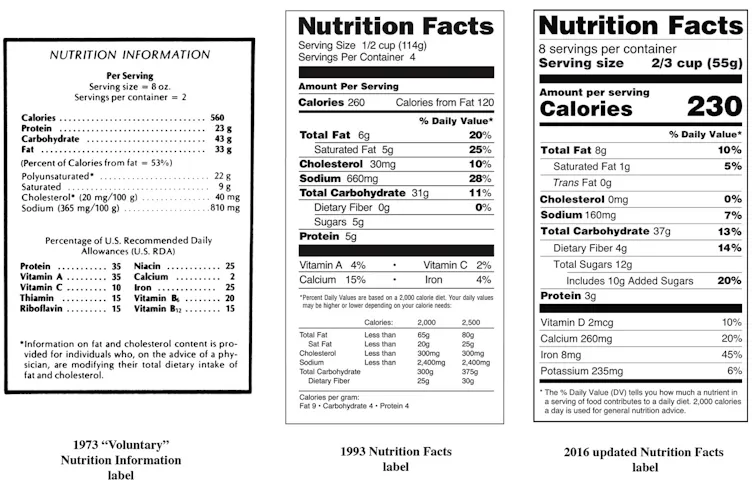
In Europe, conversations around standardising food labels gained momentum between the 1970s and 1980s (the pre-EU era), during which many high-income countries in the region (e.g., the UK, France, West Germany, and Norway) implemented voluntary labeling (like the U.S.) before fully adopting mandatory nutrition facts labelling in the 1990s-2000s. Similarly, countries in Oceania like Australia and New Zealand also developed the Food Standards Code that guides food safety and nutrition labelling in the late 1990s. In order to effectively help consumers to interpret BoP nutrition information, which may be complex most times, most developed countries have introduced different front-of-package (FOP) labelling systems like Nordic Keyhole, Nutri-Score, Stop-sign Warnings, and Health Star Rating, and colour-coded systems like TLL over the years.
While high-income countries set early precedents for standardised nutrition labelling, LMICs adopted varied approaches to address their public health concerns and regulatory priorities to suit market conditions. Most LMICs had to initially address issues around food safety and adulteration rather than nutrition transparency. For example, Bangladesh enacted its Pure Food Ordinance of 1959 to control food adulteration and misleading labels. Similarly, in India and Nigeria, early food labelling policies were embedded within food safety and anti-adulteration laws, guided by the Prevention of Food Adulteration Act (1954) and the regulatory framework of the National Agency for Food and Drug Administration and Control (NAFDAC) [1993], respectively. These regulations gradually evolved to include nutrition labeling and ingredient disclosure in alignment with the Codex Alimentarius guidelines. In contrast, China enforced Decree 208 earlier on in 1991 to curb deceptive claims and also mandated clear and standard display of nutrition information on food products. Notably, Peru and Chile in Latin America were among the first LMICs to adopt front-of-package warning labels to help consumers quickly identify unhealthy products as a measure to address rising concerns about obesity in children and other diet-related diseases. However, many LMICs are still lagging in adopting these simplified innovations for consumer guidance due to weaker regulations, structures, and resource constraints.
An Overview of the Traffic Light Labelling System
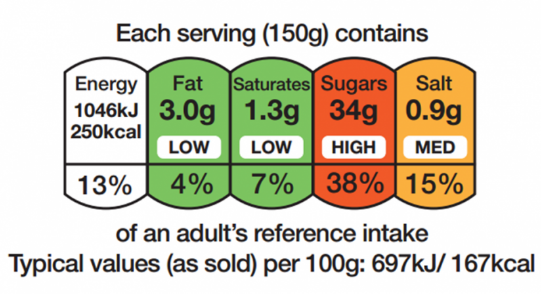
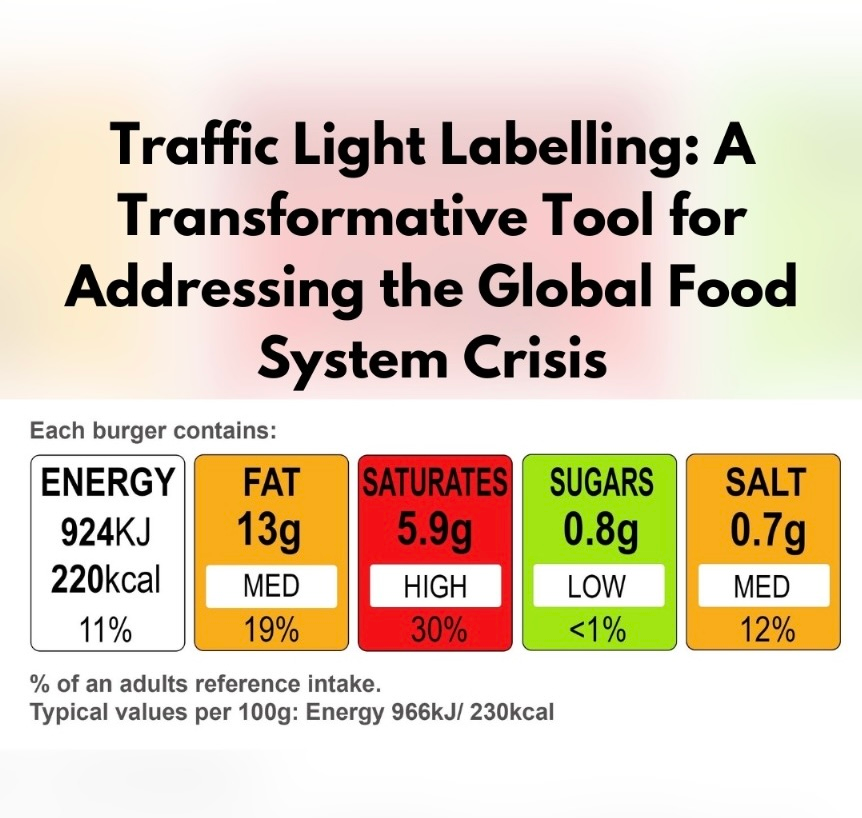
TLL is a colour-coded system launched by the Food Standards Agency and the UK Department of Health and Social Care (DHSC) as part of efforts to improve public health and provide consumers with clear, easy-to-understand nutritional information. It was first introduced in 2006, but the current voluntary scheme was introduced in 2013 and is widely used by many major food manufacturers and supermarkets throughout the UK. The system is one of the most straightforward FoP labelling schemes, providing consumers with a quick visual cue to assess the nutritional quality of a product, with red, amber, and green lozenges indicating high, moderate, or low levels of critical nutrients, respectively (Figures 2 and 3). Additionally, energy is reported in kJ/kcal per serving with reference intakes (RI) listed per 100g or 100ml in compliance with EU regulations. These percentages, determined by professionals in food science, assist consumers in monitoring whether they are exceeding or falling short of their daily allowance for energy, fats, saturated fats, sugar, and salt in a serving of food or beverage. In the case of the food label in Figure 2 above, the amount of sugar is 38% of the total recommended daily intake; therefore, the consumer taking a serving of that food product should be mindful of the amount of sugar consumed in other foods throughout the day.
Consumer Perception and Behavioural Impact of TLL
A 2020 study that sought to examine if TLL affects consumers’ tastiness expectations and purchase intentions of products in an undesired way found that TLL assisted consumers in differentiating the healthfulness of the food items based on their sugar content. The results of the study further revealed that consumers already use numerical information (usually in BoP) regarding the sugar content to distinguish between products’ levels of healthiness, aligning with that of previous studies. However, the TLL aided consumers to easily rate the healthiness of different products, and interestingly, the presence of TLL did not reduce purchase intentions or expected tastiness for low-sugar goods but marginally raised consumers’ willingness to buy low-sugar items.
Additionally, findings from more consumer studies and choice experiments indicate that customers seem to behave positively to TLL’s influence, as its clear and simple colour-coded format encourages healthier purchasing intentions and more informed food choices. One key study reported “a strong preference on the part of respondents to avoid a basket of goods containing a mix of foods with any ‘red’ lights,” suggesting that TLL serves as an effective nudge toward healthier dietary choices, although real-world purchasing behaviours may differ, particularly in settings where consumers are not directly observed or surveyed.
TLL’s Role in Promoting Environmental Sustainability
The TLL system provides a quick and accessible means for consumers to assess the levels of unhealthy ingredients such as sugars, fats, and salt in food products. However, while TLL’s impact on individual health is undeniable, its influence extends beyond just personal well-being to shape broader systemic issues like the global syndemic. The intersection of obesity and climate change cannot be overlooked, as both are driven by excessive consumption of unhealthy, resource-intensive foods. The overconsumption of processed foods high in sugar and unhealthy fats is a key driver of obesity and metabolic diseases while simultaneously being linked to resource-intensive food production, deforestation, and greenhouse gas (GHG) emissions. TLL indirectly promotes environmental sustainability by nudging consumers towards lower-carbon, whole-food diets, which often involve plant-based and minimally processed options. Reducing the consumption of such foods can:
- Lower the prevalence of diet-related diseases, reducing healthcare burdens.
- Decrease the demand for high-emission food production, such as industrial livestock farming.
- Reduce reliance on heavily processed and packaged foods, which contribute to plastic waste and energy-intensive supply chains.
TLL indirectly promotes environmental sustainability by nudging consumers towards lower-carbon, whole-food diets, which often involve plant-based and minimally processed options. However, while this approach benefits public health and contributes to sustainability efforts, it does not provide explicit information on the environmental impact of food choices.
Integrating Sustainability into Consumer Choices with TLL Environmental Labels
Recognising the need for more direct sustainability indicators, researchers and policymakers have expanded traffic-light-style labeling to include environmental metrics. The Traffic-Light Front-of-Pack Environmental Label applies the same color-coded logic as nutritional TLL but instead focuses on a product’s carbon footprint, water usage, and overall ecological impact. This system enables consumers to consider both health and environmental sustainability when making food choices.

Beyond guiding individual purchasing decisions, the label also encourages food manufacturers to adopt more sustainable practices. Research shows that the food industry is a major contributor to greenhouse gas emissions, land use change, and biodiversity loss. A comprehensive meta-analysis of global food supply chains quantified this impact, estimating that the food system generates approximately 13.7 billion metric tons of CO₂-equivalent annually, accounting for roughly 26% of all anthropogenic greenhouse gas emissions.
TLL can drive a radical change to motivate the food industry to reduce carbon emissions and resource consumption by improving the environmental ratings of food products. In turn, consumers are empowered to support low-emission diets, for example, by opting for plant-based alternatives over high-carbon-footprint animal products. Additionally, as awareness of environmental costs grows, TLL may also help combat food waste, guiding consumers toward more sustainable food choices and reducing unnecessary consumption.

Challenges and Criticisms of the Traffic Light Labelling System
Despite its widespread adoption as an innovation to improve public health intervention, the TLL system is not without limitations. Criticisms range from concerns about oversimplification to resistance from the food industry and difficulties in adapting the system to diverse consumer populations, particularly in low- and middle-income countries (LMICs).
1. Oversimplification of Nutrition Information
One of the primary criticisms of traffic light labelling is that it can oversimplify the complexities of nutrition. Critics argue that reducing a product’s nutritional quality to a single colour may obscure the nuances of its overall health profile. For example, the classification of fruit juice and sugary soft drinks under a similar “red” label due to their sugar content overlooks the fact that fruit juice provides essential vitamins and fibre, making it the relatively healthier option. Similarly, nutrient-dense foods such as nuts and dairy may receive “red” indicators due to their fat content, despite their contributions to a balanced diet through healthy fats and micronutrients. This lack of context can lead to unintended consequences, where consumers avoid beneficial foods based on a simplistic interpretation of the labels.
Moreover, TLL is primarily designed for comparisons within the same product category rather than across different food groups. For instance, it helps consumers decide which breakfast cereal is healthier but is not necessarily useful for comparing a cereal to a yoghurt or a salad. The effectiveness of TLL relies on consumers using it within its intended scope, yet there is often a tendency to generalize its implications across all food choices.
2. Industry Pushback and Economic Interests
The food industry has raised concerns about the potential for traffic light labels to negatively impact product sales. Companies may resist the system, particularly those whose products are heavily reliant on unhealthy ingredients. This resistance is often based on the fear that “red” labels could deter consumers from purchasing their products, leading to decreased market share. The food industry may attempt to subvert such regulations through lobbying or by developing alternative labelling systems that are more favourable to their interests, such as the “nutrition scores” used in some countries.
In some cases, companies may also try to reformulate products to improve their labelling status, but these reformulations may not always result in healthier options. For instance, to avoid a “red” label, manufacturers might reduce sugar content but increase the use of artificial sweeteners or fat substitutes, which may not necessarily improve overall health outcomes.
3. Challenges of Implementing TLL in Low- and Middle-Income Countries (LMICs)
The global adoption of TLL faces additional challenges in LMICs, where resources for implementation may be limited and dietary patterns vary significantly. LMICs often face difficulties in setting up the infrastructure needed for widespread labelling systems and consumer education programs. Moreover, the effectiveness of TLL may be reduced in these regions if it does not account for local food systems, cultural preferences, and the affordability of healthier options.
Additionally, there is the issue of food insecurity, where people may be more concerned with the price and availability of food than with its nutritional content. The adoption of TLL could inadvertently stigmatise affordable, culturally relevant food options as “unhealthy,” thus increasing food insecurity and creating unintended consequences.
Strengthening TLL for Greater Impact: The Way Forward
Collaboration among key stakeholders like governments, public health organisations, food industries, and consumers is essential for the successful implementation of traffic light labelling. Policymakers must work closely with food manufacturers to develop clear and enforceable guidelines that address industry challenges while taking regional and cultural differences into account. In LMICs, partnerships with local organisations can help develop tailored systems that align with local food systems, dietary habits, and affordability, which are crucial for driving consumer behaviour change.
In addition to collaborative efforts, consumer education plays a key role in ensuring the success of TLL. Effective public awareness campaigns are needed to educate people about the significance of the labels and how to interpret them. These campaigns should especially target vulnerable groups, including children and low-income families, to empower them to make healthier choices. Furthermore, traffic light labelling must remain adaptable to the evolving global food system, ensuring that it stays relevant as new products and trends emerge. Expanding global adoption of TLL is vital, particularly in regions where it is not yet implemented, as this can help address global food system crises and improve public health outcomes. Integrating the system into broader sustainability policies will further promote healthier eating and support environmentally friendly food production practices.